

Dual-Form Pavilion
BI-CITY BIENNALE OF URBANISM / ARCHITECTURE
Space × Structure × Sustainability Laboratory(S³ Lab), The University of Hong Kong / Faculty of Architecture, Harbin Institute of Technology (Shenzhen)
Structural Design:
Ting Cao, Jiatao Huang, Shengkun Liang
Construction Team:
Ting Cao, Jiatao Huang, Shengkun Liang, Kaizhong Yang, Zhendong Xu, Mengqi Xia,
Haiqi Tong, Nuoyan Xu
Assistance & Support:
Gang Yu, Bing Zhang, Zongshuai Wan

Close-up view of Linear Pavilion of BI-CITY BIENNALE OF URBANISM / ARCHITECTURE, Shenzhen, China, 2026.
Design Concept
As part of the Boundary Topology series, Dual-Form Pavilion takes the century-long evolution of the Shenzhen–Hong Kong boundary as its design background. Rather than treating the boundary as a fixed division, the installation represents it as a flexible spatial condition shaped by use and activity.

Structure Design Process
Employing circular construction techniques and smooth poly-hypar surface structures, the installation realizes this concept by using the same set of straight rods and planar joints to form two configurations: Linear Pavilion and Cluster Pavilion.
Located in the Shenzhen–Hong Kong Central Park in the Hetao area, the project is first assembled as Linear Pavilion and later dismantled and reconfigured into Cluster Pavilion, demonstrating structural superposition across different spatial forms.
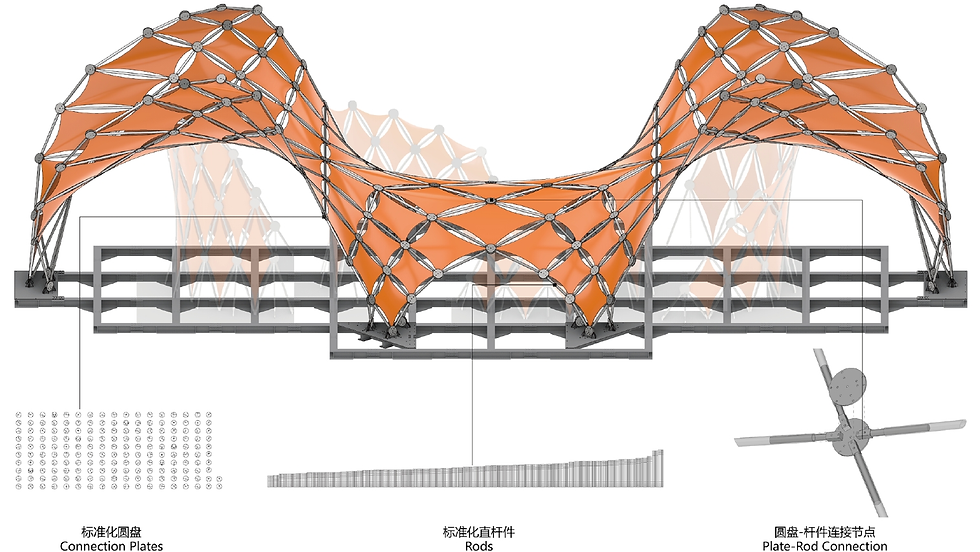
Form Ⅰ:Linear Pavilion

The front view of Linear Pavilion

Interior view of Linear Pavilion

Side View of Cross Section

Linear Pavilion under the setting sun

Children's activities under Linear Pavilion
Linear Pavilion differentiates adult and children’s spaces through horizontal continuity and height variation, while Cluster Pavilion vertically partitions and encloses space.
Through its transformation, the installation invites reflection on the site’s spatial specificity and introduces the potential of circular construction in public space.

Form Ⅱ:Cluster Pavilion

Children's activities under Cluster Pavilion

Cluster Pavilion in the distance

Close-up view of Cluster Pavilion

Cluster Pavilion divide and enclose space vertically

Construction video