
News & Events

Discussion Series Spring 2026
From 12-14 May 2026, the Department of Architecture at The University of Hong Kong will host a workshop comprising a series of public lectures, teaching and curriculum discussions, and presentations on design, practice, and research.
The coordination team is led by Prof. Kam-Ming Mark Tam and Xiaoxiao Wu, P.E. (Guy Nordenson Associates) from the Hong Kong and U.S. sides respectively, together with HKU’s Prof. Ting Cao, Prof. Heng Xia, and Prof. Hongshan Guo, with generous support from Prof. Davide Spina, Prof. Chang Su, and Prof. Eunice Seng from the Department of Architecture, as well as participation from the Department of Civil Engineering through Prof. Wei Pan, Prof. Jiaji Wang, and Prof. Wai Yuen Szeto.
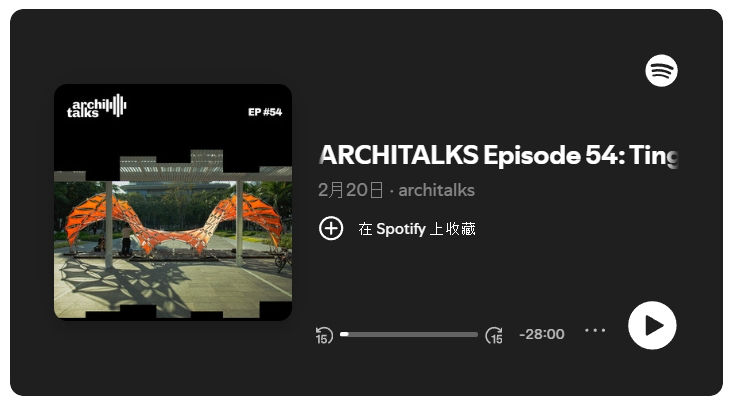
ARCHITALKS Episode 54
In this episode of ARCHITALKS, Ting Cao, Assistant Professor of Architecture at The University of Hong Kong, speaks about her design and construction of the Dual Form Pavilion sited at the Hong Kong-Shenzhen Park for the SZ Bi-City Biennale 2026, which is presented through two iterations as the Linear Pavilion and the Cluster Pavilion. We discuss the technical, aesthetic and spatial aspects of the project, circular construction, how the residents in the community respond to and use the structure, especially the children, and its future application in Hong Kong pedestrian spaces; and reflect on the intersection between technology and art.

Dual-form Pavilion, Reconstruction with us,Hetao District, Shenzhen, 03 2026
Demonstration of knowledge related to circular reuse design concepts.
Miniature model construction: Participants, particularly children, may join students in assembling models to experience the architectural structural design process.
AR architectural space experience: By scanning QR codes with AR devices, participants may view digital representations of design proposals, with students providing explanations of design details to visitors.

“Design for Reuse”, Exhibition with Augmented Reality, HITSZ, 2024
Demonstration of knowledge related to circular reuse design concepts.
Miniature model construction: Participants, particularly children, may join students in assembling models to experience the architectural structural design process.
AR architectural space experience: By scanning QR codes with AR devices, participants may view digital representations of design proposals, with students providing explanations of design details to visitors.

We build for people
WHY WE DO WHAT WE DO
We aim to develop an ideal model through integrated structural design. However, in architectural design, structural performance is not the sole dimension shaping form; morphology must engage with its context. This necessitates maintaining a degree of openness within the structural conceptual design process. Three-dimensional diagrammatic static analysis offers a rational, feedback-driven design tool, enabling technology to actively participate in architectural aesthetics. Technical rationality continually integrates with the humanistic environment.